

"RuffRuff 予約販売" helps reduce the opportunity losses that occur when an item is out of stock, before a new product launches, or while waiting for restock.
It lets you set up pre-orders on your own Shopify store with surprising ease, and you can register unlimited pre-order items and accept unlimited pre-orders. It can also restrict customers from ordering pre-order and regular items together in the same order, and can notify customers when a restock date is undetermined.
It also offers many unique features not found in other pre-order apps, such as a "deferred payment" feature that lets you collect payment before the item ships.
Are you doing email marketing?
Among the many marketing methods available to an ecommerce site — SEO, social media, advertising, and more — email marketing is one of the important ones.
In this article, we cover the benefits and drawbacks of email marketing, and introduce recommended Shopify apps for putting email marketing into practice.
What is email marketing?
Email marketing is, as the name suggests, a marketing method that uses email.
It's a practice of sending emails to your customer list to achieve goals such as attracting customers, building relationships with them (turning them into fans), and driving product purchases.
On Shopify, many convenient email delivery tools like Klaviyo and Omnisend have emerged, making it possible not only to send a single email to your whole customer list, but also to deliver emails at optimized timing and with optimized content per customer, or even automatically send emails based on certain conditions.
Benefits of email marketing
Builds an ongoing relationship with customers
As marketing methods, SEO and social media are ideal for acquiring new customers, but email remains the best method for maintaining and strengthening relationships with existing customers over the long term.

Source: Comparison by industry chart
According to data from 200 million emails sent via Constant Contact, as of November 2022 the average email open rate was 33.86%, the click rate (clicks/sends) was 1.33%, and the bounce rate was 10.16%. What this data shows us is that even now, when chat has become commonplace, one in three customers still reads their email.
Email is one of the best channels for maintaining and strengthening long-term relationships with customers. It also plays an important role in driving repeat purchases from customers.
Beyond email, LINE is also an effective way to communicate one-on-one with customers on Shopify. The blog article below covers the benefits and drawbacks of using LINE with Shopify, along with recommended apps. Please use it as a reference.

An ideal medium for driving action
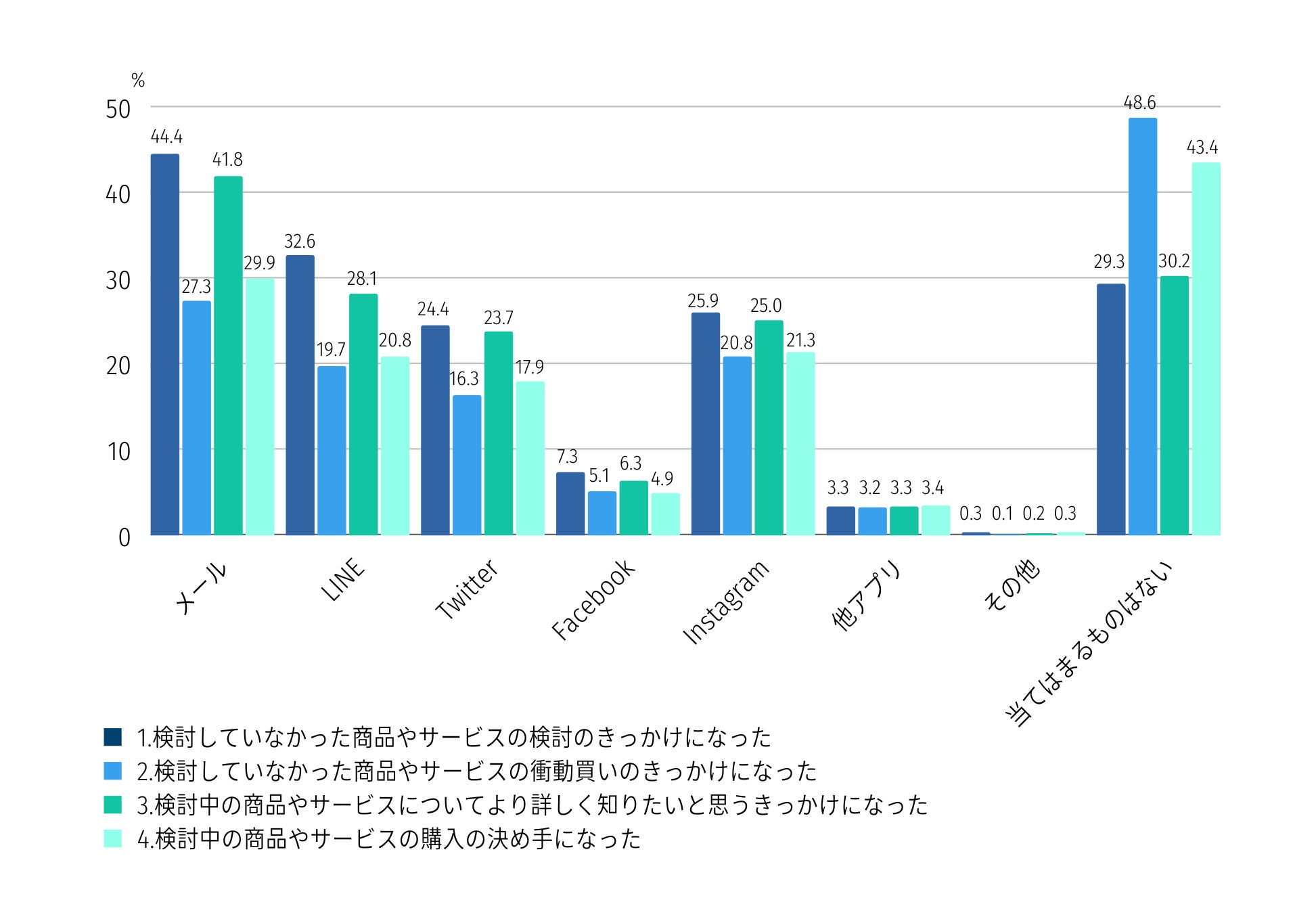
In a 2022 "Awareness Survey on Email" conducted by Link Corporation, which provides the email relay service "Bear Mail", the proportion of people who said email "prompted them to consider and purchase a product they hadn't been considering" or "made them want to learn more about a product they were already considering, or became the deciding factor in their purchase" was higher than for media such as LINE, Twitter, Facebook, or Instagram.
Low cost and easy to get started
Marketing measures for ecommerce sites come in many forms, with approaches ranging from web and social media ads, to publishing videos, to flyer distribution. However, these measures all come with a certain amount of cost. Companies without a sufficient budget may not be able to run satisfactory tests, and may end up abandoning their efforts partway through.
Email marketing can be started at relatively low cost. As long as you have a computer or smartphone, an email address, and an internet connection, you can start right away.
High cost-effectiveness
Email marketing targets people who have voluntarily subscribed, are already interested in your products, or have already purchased from you. Because of this, you can expect better results than marketing measures aimed at an unspecified general audience, and it offers high cost-effectiveness.
What's more, by repurposing blog articles that performed well on your own store for email marketing, you can efficiently create high-quality content at low cost.
If you haven't yet made use of Shopify's blog feature, the blog article below explains Shopify's blog feature — please use it as a reference.

Also high CVR

Source: Shopify Blog
This is specifically about Black Friday/Cyber Monday sales, but according to Shopify data, during sales, email is the channel with the highest order conversion rate, compared to organic traffic or social media traffic.
Less affected by platform changes
With things like ads or SEO, changes to Google's or Facebook's algorithms or specifications can cause ad costs to spike or sales to plummet, but email marketing isn't affected by that.
Easy to measure results
With SEO, you can't always precisely track who came in through which search keyword and made a purchase, and with flyers you can't even track numerically whether they actually reached the mailbox or were read at all. Email, on the other hand, is a channel that's easy to measure, since you can check figures like how many people you sent to and what the open rate and click rate were. Being easy to measure also makes it easy to run hypothesis testing on your measures and continuously refine them.
With major Shopify email apps like Klaviyo and Omnisend, you can even track who opened an email, who clicked, and who went on to make a purchase.
Drawbacks of email marketing
Requires human resources
Email marketing requires you to keep delivering content your customers actually want, so they don't get bored, come to dislike your emails, or unsubscribe. This requires human resources to produce that content.
Cost isn't zero
We mentioned "low cost" as a benefit, but it's difficult to bring operating costs down to completely zero.
Running email marketing incurs at least some labor cost.
You'll also need to introduce an email delivery tool for efficient email marketing operations. If you do introduce one, you'll incur additional operating costs such as setup fees and monthly fees.
If you use a Shopify email app as your delivery tool, you can at least get started for free, without setup fees or monthly fees.
Getting flagged as spam can also block your regular email
Various factors — delivery speed, sending in bulk, email content, and more — can cause the email address you're using to be flagged as spam, preventing your emails from reaching customers. If you're reusing a single email address, you risk not just your marketing emails but also regular emails like shipping notifications failing to get delivered. Considering the worst case, we recommend keeping your marketing email address separate from your regular one.
Risk of human error

In 2021, Japan's Digital Agency had an incident where email addresses leaked. When using a tool like Gmail where email addresses are entered manually, mistakes like mixing up "To" and "BCC" — as happened at the Digital Agency — can occur. Mistakes like misspelling names also happen.
To minimize manual work, use a dedicated email delivery or MA tool. Shopify offers convenient email apps like Shopify Messaging, Klaviyo, and Omnisend, so try to use a Shopify app wherever possible.
Types of emails sent from ecommerce
Transactional emails
Transactional emails are more functional in nature — sent during checkout or other purchase actions, delivering important information to individual customers. Examples include order confirmation emails, receipts, and shipping notification emails. On Shopify, transactional emails are sent automatically via the notifications feature.
Promotional emails
Promotional emails are created to raise awareness of a specific deal or promotion. Examples include Black Friday/Cyber Monday, Mother's Day or Christmas gift guides, New Year features, Valentine's Day features, and limited-time discounts.
Scenario emails
Scenario emails are also known as lifecycle emails or trigger emails. These are emails sent based on customer behavior or where they are in their lifecycle. Examples include "send an email when a cart is abandoned" or "send an email when a customer visits a product page 3 times". You can automate this by using a Shopify email delivery app with an automation feature.
Drip emails
Drip emails are sent based on a specific date. Examples include "send 1 day and 1 week after a product order" or "send 1 week after a materials request". Drip emails can also be automated using a Shopify email delivery app with an automation feature.
How to choose a Shopify email delivery app
Does it have the features you need?
There are many Shopify apps that let you send email.
Any of them can probably send email, but check whether they offer an "automation feature" to automate and streamline your email marketing, an "analytics/dashboard feature" to refine your email content and strategy, and a "signup form feature" for collecting email addresses.
How much does it cost?
Many Shopify email apps let you start for free initially. That said, the cost changes based on the size of your customer list and the number of emails you send. Estimate how large your customer list and email volume are likely to grow, and roughly how much that would cost.
Is it easy to use?
Some apps have so many features that they actually become harder to use. At the very least, check whether the email editor itself is easy to use.
4 recommended Shopify apps for email delivery
Shopify Messaging (formerly Shopify Email)

Shopify Messaging (formerly Shopify Email) is Shopify's own native messaging delivery app.
With this app, Shopify store operators can handle everything from creating and sending newsletters to data analysis, template management, and SMS delivery, all within the Shopify admin. It also lets you send up to 10,000 emails per month for free, making it one of the most affordable options among email delivery apps.
Price: Free~
※ Free for up to 10,000 emails a month; $1 is charged for every 1,000 emails beyond that.
The blog article below covers the features, usage, and pricing plans of Shopify Messaging. Please use it as a reference.

Klaviyo

One of the most popular email delivery apps among Shopify apps. It's characterized by having everything you need for email delivery, along with a rich selection of Shopify apps it can integrate with. With Klaviyo, you can also set up automated emails such as "automatically send customers an email with XX content at YY timing".
It can also display a restock notification form when an item is out of stock, and automatically email anyone who signed up for restock notifications once the item is back in stock.
Price: Free~
※ Free for up to 250 emails. Free for up to 50 SMS messages. Beyond that, it's a paid feature. Please check the official page for details
The blog article below covers in detail the benefits of using Klaviyo and how to set it up. Please use it as a reference.

Omnisend

Omnisend is the second most well-known email delivery app after Klaviyo. It's relatively less expensive to get started with compared to Klaviyo, and although the admin is in English, it's laid out clearly, giving an intuitive, easy-to-use impression.
Price: Free~
※ Free for up to 500 emails/month. Free for up to 250 SMS messages/month. Beyond that, sending more requires a paid plan. Please check the official page for details
The blog article below covers Omnisend's pricing and initial setup process. Please use it as a reference.

Dotdigital

Dotdigital is a marketing automation (MA) tool used by over 4,000 companies worldwide. It boasts strong integration with Shopify, supporting the use of customer metafields, two-way data sync, and integration with Shopify Flow.
By making use of your customer data on Shopify, it enables effective customer communication across a variety of channels including email, SMS, LINE, social media ads, and app notifications.
Dotdigital also comes with its own built-in AI that can automatically analyze customer data. Personalized product recommendations can be embedded into emails with a single click, and it's highly usable.
The blog article below covers Dotdigital's features, recommended functionality, and setup process. Please use it as a reference.

Finally
Email marketing is one of the key marketing methods for running an ecommerce site. While it can be started at low cost and offers high CVR and cost-effectiveness, you also need to account for the human resources needed to produce content and the operating costs of your tools.
On Shopify, you can run effective email marketing by making use of various email delivery apps such as Shopify Email, Klaviyo, and Omnisend. Since each app has its own strengths, it's important to choose the tool that best fits your budget and the features you need.
To succeed with email marketing, it's important to continuously deliver content that matches your customers' needs and communicate with them at the right timing. Also, don't forget to set up a proper operational structure — for example, taking precautions against being flagged as spam, and using automation to prevent human error.
Finally, in addition to email delivery apps, the blog article below introduces various recommended apps by category, including "attracting customers", "growing sales", and "expanding blog features". Please use it as a reference.


