

Noguchi Knit, a long-established knitting factory in Osaka founded in 1927, has continued its business behind the scenes for many years as an OEM manufacturer. Before the company launched its own brand and transformed into a D2C brand, it went through a great deal of trial and error, friction with the manufacturing floor, and a strong sense of crisis.
We spoke with Yuko Kamitsubo, wife of the company's current president, who joined the factory as the "wife of the successor," about her real, unvarnished journey — from manufacturing and sales to branding and the move to Shopify.
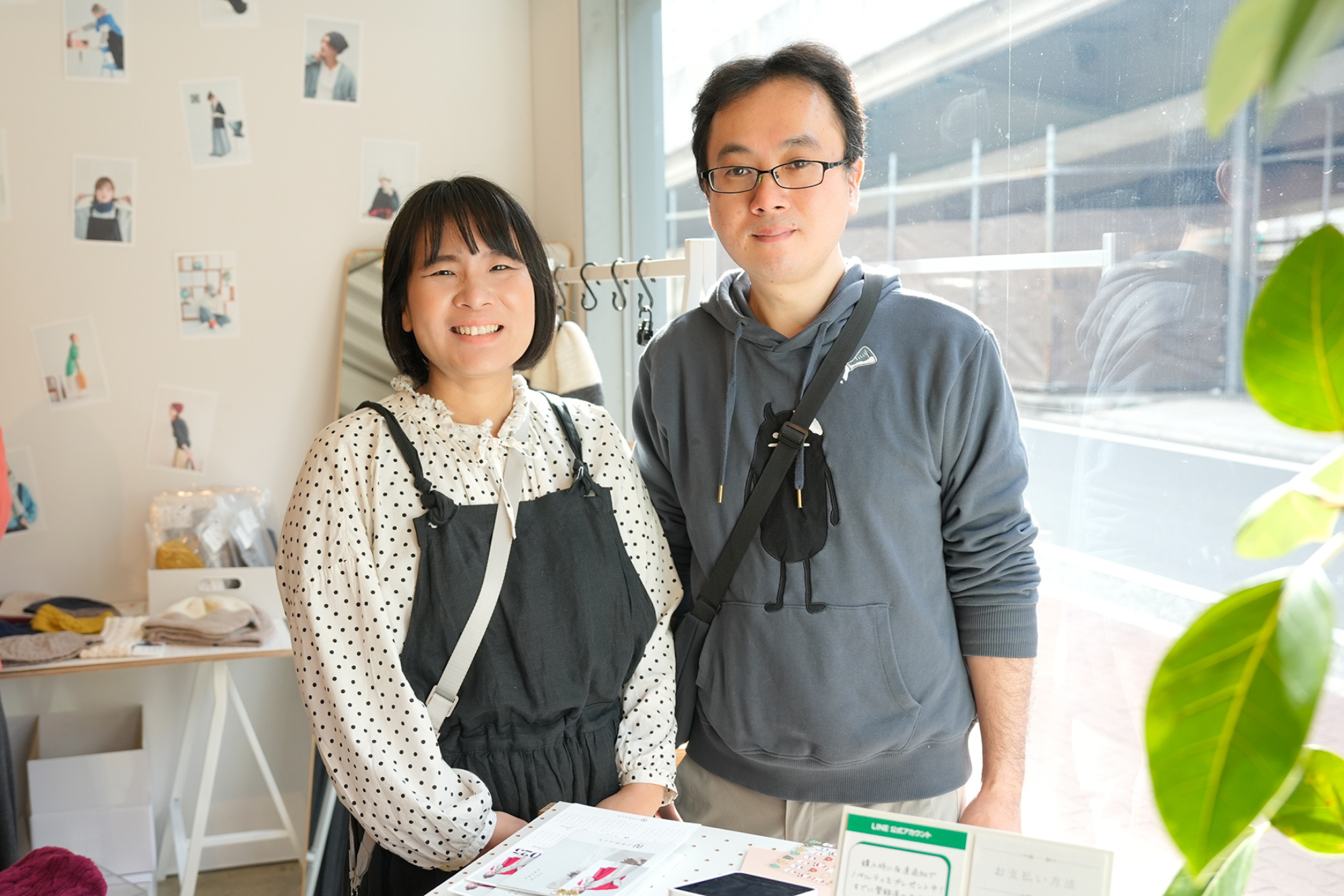
(Noguchi Knit Co., Ltd. — Tetsuya Kamitsubo (left), Yuko Kamitsubo (right))
Breaking Away from a Factory That Only Ever Subcontracted
— First, could you tell us about the evolution of Noguchi Knit's business?
Kamitsubo Noguchi Knit was founded in 1927 and has long operated as a subcontract factory producing knitwear. We never had products under our own name, and ours was a completely behind-the-scenes position — our name never appeared anywhere.
Previously, we manufactured sweaters as OEM products, and we specialized in sweaters for ski apparel in particular. But as the culture of wearing sweaters for skiing faded, and new materials emerged, the factory also shifted direction toward making knit caps. We managed to survive by scaling down, even as sales declined.
In the midst of that, I joined the company as the wife of the family. At the time, sales were still reasonably steady, but when I heard my husband say, "We buy in wool yarn and products go out the door," I thought, "Then why don't we just make and sell our own products?" It was a completely amateur idea, though (laughs).
—— Did you think from the very beginning, "Not subcontracting, but our own products"?
Kamitsubo Yes. From the moment I joined the company, I had a desire to sell our own products. But we hadn't even decided what to sell, and at first it was really trial and error. I left my office job when I got married, and started by learning how to use a sewing machine. I spent years working eight hours a day at the machine, and since I happened to be good with my hands, I became reasonably capable at manufacturing too. My days were filled with subcontract work, but I always kept thinking, "I want to sell our own products."
But if I couldn't properly handle manufacturing, I wouldn't be trusted within the company. That's exactly why I spent my own time on manufacturing while gradually making preparations on the side.

Taking On an In-House Brand with Zero Apparel Experience
—— You entered the apparel business without any experience — did you have any particular interest in or passion for apparel?
Kamitsubo Honestly, I had no desire at all for self-expression or to launch a brand. But I had a strong sense of crisis that "we can't keep going as just a subcontractor." I felt that if we depended on a single client for work, we'd be unable to carry on if anything happened to that relationship — so building our own brand felt like the only option.
—— Did you face difficulties taking on a new business as the successor's wife?
Kamitsubo Yes, there were. Even when I started something new, the perception within the company barely changed — people kept thinking, "the wife is just doing her own thing." No matter how much revenue it generated, that didn't change how the staff saw it.
On my days off, I'd borrow the factory's machines and sell the products I made myself, but within the company the mood was, "she's just doing it on her own," "it's probably just a hobby" — the staff weren't involved, and there was no support. It took several years before I was even allowed to use staff, and there was pushback too, like, "why do we have to be dragged into the wife's hobby?" So at first, it really was just my husband and me scrambling to make it work.
The factory floor especially is a world with no connection to social media or marketing. When I tried to film a video, people would say, "I don't want to be on camera," and it was difficult even to share glimpses of the factory. But since everyone there is focused purely on manufacturing, I think that's understandable. So rather than force change, I try to work within what we can do ourselves.
Trial-and-Error Sales That Began with a Tent Stall
—— When did your own brand actually get started?
Kamitsubo I got married and joined the company in 2011, and by the winter of the following year, 2012, I had prepared products and made our first sales. At first, I set up a stall at a handmade goods market and tested the waters, watching customers' reactions and thinking, "will this actually sell?" I had zero experience in apparel or sales skills, so there was nothing to do but learn on the ground.
At first we set up a tent and sold there, but it didn't sell at all (laughs). Still, hearing customers' real reactions in person, and seeing the products of other successful makers, taught me a great deal.
That said, I also keenly felt the reality that "you can't sell to people who aren't interested." Events drew a lot of tourists, many of whom weren't there to shop in the first place. Just getting people to stop and look was hard enough.
—— From there, how did you move into e-commerce?
Kamitsubo Around 2014, handmade marketplace sites like minne and Creema started gaining momentum, so we began selling on minne too. At first I didn't expect much, but at some point we got featured in the site's picks, and sales took off. With zero ad spend, we once made 3 million yen in sales in just the three winter months.
But at this point we were completely reliant on the platform — if we weren't featured by the operator, we didn't sell, and we had no control over our own sales. This is what led to the idea that "we should have our own website."
—— When sales on minne started growing, what changes did you notice?
Kamitsubo Being featured brought attention, and I really felt "the power of photography is amazing." From there, I started thinking on my own and learning about "how to shoot to make things look appealing."
For the shoot location, I even put up wallpaper in a corner of the factory and used my smartphone to photograph products draped on a torso mannequin. Looking back, it was all amateur work, but I was desperate. Still, it was an era when getting featured on minne or Creema could really drive sales.

(Noguchi Knit's shop on minne)
The First Step into E-Commerce: STORES
Kamitsubo Even as sales on minne grew, I always had a nagging worry that "this might be temporary." Whether we got featured came down to luck, and we had no control over our own sales. Just as I was thinking "this can't go on like this," in the summer of 2019, I got the chance through an acquaintance to talk with a senior entrepreneur who ran a sock brand.
What that person told me — "from now on, you have to have your own website" — really struck a chord. Being told, "not being able to send a newsletter is fatal," and "a business that doesn't accumulate customer data isn't really a business," made me realize for the first time how important a customer list is.
That person gave me advice on how to grow our own e-commerce site, and I made a checklist of around 30 items myself, working through them one by one over several years. "Add a QR code to the flyer we include with orders," "include a letter," "add a blog to the site" — I tried absolutely everything.
—— So at that point, you still didn't have your own website?
Kamitsubo That's right. I compared several services. At first I signed up with Color Me Shop and paid 5,000 yen, but achieving the design I wanted would have required a full custom build from scratch. BASE and STORES were just starting to appear, and I chose STORES because it looked like something I could start simply. Being able to set it up for free was also a big point in its favor.
—— How did sales go on STORES?
Kamitsubo For the first few months, it didn't sell at all. But I was already used to things not selling, so I kept going without worrying too much about it (laughs).
Then in 2020, the COVID-19 pandemic hit, and a pollen-blocking mask we happened to be making suddenly saw a surge of traffic, generating tens of millions of yen in sales with zero ad spend.
However, production couldn't keep up, complaints increased, and the floor grew more and more exhausted. Even so, it was that revenue that let me think, "let's build a site with exactly the design we want."
Rebuilding the Site and Brand with Shopify
—— Why did you choose Shopify?
Kamitsubo I compared several cart platforms, and Shopify was by far the coolest. The design of the sites featured as case studies was overwhelmingly good, and I thought, "if I can build a site like this, let's do it." The admin dashboard is simple and easy to use, too. We started preparing around the autumn of 2020 and relaunched on Shopify in April 2021.
Moving to Shopify was a great decision. In particular, it works really well with advertising and social media. The admin dashboard is easy to use, and while there are many apps available, we were able to pick just the ones we actually needed and build a simple setup.
That said, the move to Shopify was a major project. We ended up rethinking everything — how to present ourselves as a brand, including visuals and concept — and spent more than six months, working as a team, hashing out everything down to the direction of the photography and design.
At this point, we also strengthened our branding all at once. We put into words what we had until then been doing somewhat vaguely, and made clear the core idea: "these are the kinds of products we want to deliver, to these kinds of people."

Kamitsubo The theme is a paid theme called Prestige, and we've actually barely customized it. The template is so well-made that it's easy for us to manage ourselves. Our outside production partners have also told us, "rather than tinkering with it, it's easier to manage and looks better left mostly as is."
For companies like ours without an in-house engineer, I think building without over-engineering it is best. We focused on how much of our world we could convey through images and text.
—— So you're thorough about keeping operations simple on the admin side?
Kamitsubo We have a lot of older customers, so too much information can leave them confused. Even adding a single gift card option, we think it through carefully. We examine every detail from the perspective of, "will this button confuse a customer?"
What "Afraid of Selling Too Much" Revealed About Our Brand's Core
—— What do you think was the single best thing about moving to Shopify?
Kamitsubo What I was most conscious of was "doing things within a range we can control ourselves." For instance, going viral on Instagram or getting featured on TV is, of course, something to be grateful for. But it's not always purely a good thing.
We're not a mass-production factory — we knit each piece ourselves, one at a time. There's a limit to how many we can make in a day, and our machines are limited too, so we allocate our schedule, deciding "this week is for this product." In that setup, if we suddenly get flooded with an unexpected surge of orders, the floor ends up overwhelmed.
—— So having too many orders can actually become a source of fear?
Kamitsubo Yes, it's a happy problem, but honestly, it's scary (laughs). That's why, even on social media, rather than vaguely wanting to go viral, we've focused on "properly reaching the people we're meant to reach." We think carefully about words and photos that will truly resonate with someone's heart, and shape that into something that leads to sales. That's our down-to-earth way of doing things.
In the process of shifting from OEM to an in-house brand, we heard about a range of struggles and ingenuity — gaining understanding within the company, organizing sales channels, and finding ways to make things work within limited resources. Rather than forcing themselves to appear bigger than they are, the accumulation of searching for a way to keep going at their own pace, together with their day-to-day way of engaging with the shop floor, is what shapes Noguchi Knit's brand today. We felt that this attitude — valuing authenticity over flashiness — resonates with many manufacturing sites elsewhere as well.
Part 2 of the interview, "Building Manufacturing with a Human Face by 'Not Selling Too Much,'" is available here.


